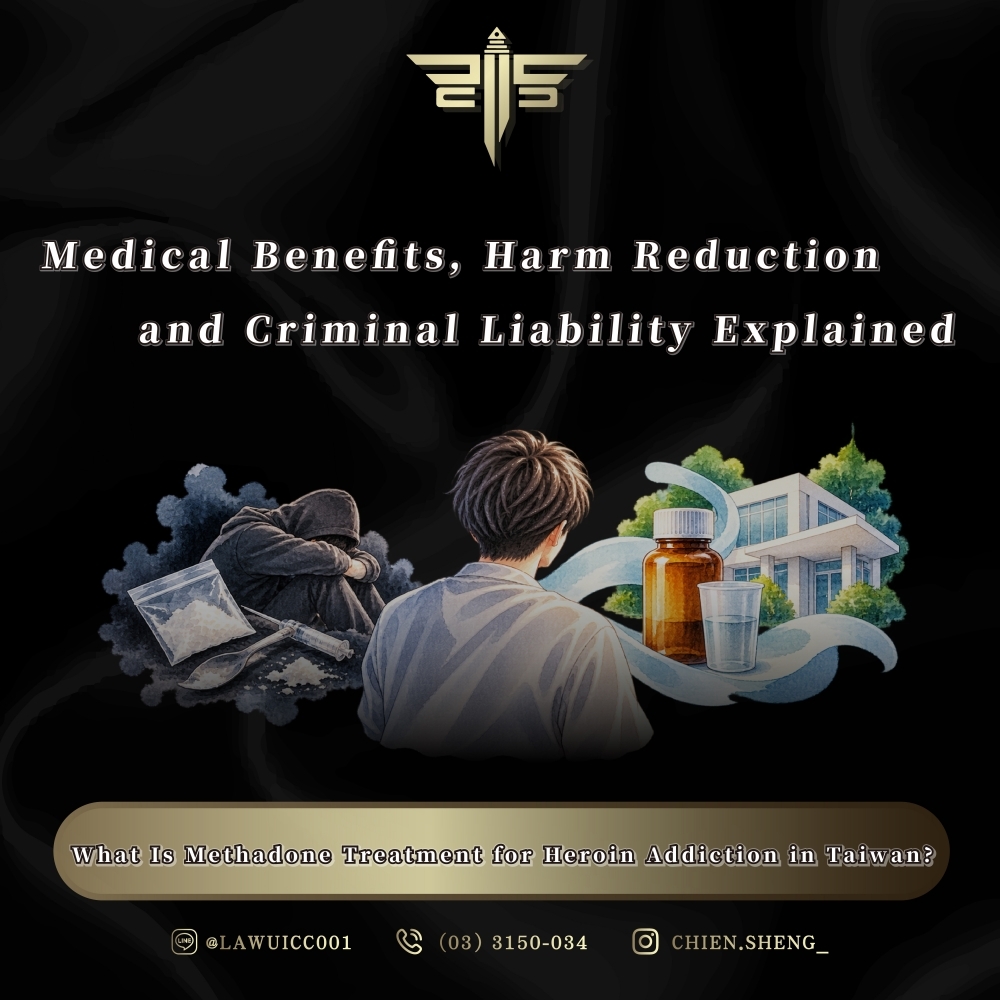
What Is Methadone Treatment for Heroin Addiction in Taiwan? Medical Benefits, Harm Reduction, and Criminal Liability Explained
商品圖像
-
商品資訊
目錄
- 1. Is Methadone Legal in Taiwan?
- 2. How Does Methadone Maintenance Treatment Work?
- 3. Why Is Methadone Considered a Harm Reduction Strategy?
- 4. When Did Taiwan Introduce Methadone Treatment?
- 5. Drug Enforcement, Addiction Treatment, and Harm Reduction: What Is the Difference?
- 6. Does Methadone Treatment Protect Patients from Criminal Charges?
- 7. What Criminal Penalties Still Apply to Heroin Possession?
- 8. Frequently Asked Questions About Methadone Treatment
- 9. How Can Patients and Families Seek Treatment or Legal Assistance?
- 10. Conclusion: Methadone Treatment Is Healthcare, Not Drug Legalization
Why can medical institutions in Taiwan provide methadone to people with heroin addiction when heroin itself is classified as a Category 1 narcotic?
Does methadone treatment mean that heroin use has been legalized, or that patients are exempt from criminal liability?
These questions often arise because drug enforcement, addiction treatment, and harm reduction are different concepts.Methadone maintenance treatment is a medically supervised approach to opioid use disorder. Its purpose is to reduce withdrawal symptoms, drug cravings, and health risks associated with illegal heroin use.
However, receiving methadone treatment does not automatically eliminate criminal responsibility for heroin possession, use, or trafficking.
This article explains how methadone treatment works in Taiwan, its legal status, and the criminal law issues patients should understand.
1. Is Methadone Legal in Taiwan?
1. Methadone Is Not Heroin
Methadone is a synthetic opioid medication used to treat opioid dependence.Although methadone and heroin both act on opioid receptors, they have different medical applications and legal classifications.
Under Article 2 of Taiwan's Narcotics Hazard Prevention Act, heroin is classified as a Category 1 narcotic.Article 10 provides that unauthorized use of Category 1 narcotics is punishable by imprisonment of six months to five years.
Methadone, by contrast, is listed as a Category 2 controlled medication under Taiwan's controlled-drug regulations.Its medical use is permitted within the applicable prescription, dispensing, and controlled-substance management framework.
2. Legal Treatment Does Not Mean Legal Heroin Use
Methadone treatment is provided through authorized medical institutions under professional supervision.
Patients must follow prescribed doses and treatment requirements.They are not permitted to obtain, distribute, or use methadone outside the applicable legal framework merely because it is prescribed for addiction treatment.
The central distinction is between medically supervised treatment and unauthorized narcotic use.
Methadone therapy does not legalize heroin possession or consumption.
2. How Does Methadone Maintenance Treatment Work?
Heroin is a relatively short-acting opioid that can produce strong physical dependence.
When a person stops using heroin, withdrawal symptoms may include muscle pain, sweating, diarrhea, insomnia, anxiety, and intense drug cravings.
These symptoms can contribute to repeated heroin use.Methadone acts on opioid receptors but has a longer duration of action. It is generally administered orally as part of a structured treatment program.
Doctors assess the patient's medical history, withdrawal symptoms, physical condition, and treatment response before adjusting the dosage.
When appropriately prescribed and monitored, methadone can stabilize withdrawal symptoms and reduce cravings without the repeated cycles of intoxication and withdrawal associated with illicit heroin use.
Treatment may also include psychological counseling, rehabilitation, urine testing, case management, and support for coexisting medical or mental health conditions.
Methadone is not an instant cure for addiction. It is one component of a broader, ongoing recovery process.
3. Why Is Methadone Considered a Harm Reduction Strategy?
1. What Does Harm Reduction Mean?
Harm reduction aims to reduce the health and social consequences of drug use, including when a person is not yet able to stop using drugs completely.
➡︎ It does not mean encouraging drug use or abandoning addiction recovery.
By reducing reliance on illicit heroin and high-risk injection practices, methadone treatment can help lower exposure to blood-borne infections such as HIV and hepatitis B and C.
➡︎ It may also help patients maintain more stable daily routines and remain connected to healthcare services.
2. What Does Medical Research Show?
The World Health Organization recognizes opioid agonist maintenance treatment as an important intervention for opioid use disorder.
Research has associated this approach with reduced illicit opioid use and improvements in treatment engagement and certain health outcomes.
Cochrane reviews have also found that methadone maintenance treatment improves treatment retention and reduces heroin use compared with non-opioid substitution approaches.
However, the available evidence does not establish that methadone treatment produces improvements in every outcome for every patient.
➡︎ Methadone also carries risks, including physical dependence, adverse effects, and overdose when used improperly.
➡︎ Methadone is an evidence-based medical treatment, not a risk-free medication or a complete solution to drug addiction.
4. When Did Taiwan Introduce Methadone Treatment?
Taiwan introduced methadone maintenance treatment as part of its drug harm reduction initiatives in 2006, following concerns about HIV transmission among people who injected drugs.
The program was developed to reduce infection risks and connect people with opioid dependence to structured medical treatment.
➡︎ By 2026, Taiwan's Ministry of Health and Welfare continued to publish information about designated addiction treatment institutions, methadone dispensing locations, cross-regional services, and treatment subsidies.
➡︎ In 2025, the ministry also established administrative requirements governing the designation and management of methadone maintenance treatment dispensing sites.
Taiwan's 2026 addiction treatment subsidy program operates from January 1 through December 31, 2026.
Eligible patients receiving treatment at designated institutions may receive subsidies for specified methadone medication and dispensing services, subject to the program's requirements.
Other medical, psychological, and rehabilitation services may be covered according to the applicable rules and individual eligibility.
Methadone treatment is therefore not a newly introduced policy, nor does its availability represent the legalization of heroin.
5. Drug Enforcement, Addiction Treatment, and Harm Reduction: What Is the Difference?
1. Drug Enforcement
Drug enforcement focuses on preventing illegal drug production, transportation, distribution, and trafficking.
Taiwan continues to impose substantial criminal penalties for serious narcotics offenses.
2. Addiction Treatment
Addiction treatment addresses substance use disorder through medical care, medication, counseling, rehabilitation, and ongoing support.
The objective is to help patients reduce or stop harmful drug use and improve their health and daily functioning.
3. Harm Reduction
Harm reduction seeks to prevent avoidable injuries, infections, overdoses, and other consequences while helping people access treatment.
These three approaches are not necessarily contradictory.A legal system can prosecute drug traffickers while providing medical treatment to people experiencing addiction.
Likewise, prescribing methadone through an authorized healthcare program is fundamentally different from distributing illegal narcotics for unrestricted use.
6. Does Methadone Treatment Protect Patients from Criminal Charges?
1. Medical Treatment and Criminal Liability Are Separate
Receiving methadone under a lawful medical prescription is different from illegally obtaining or using heroin.
However, participation in a methadone program does not automatically excuse previous or subsequent narcotics offenses.
Unauthorized possession, distribution, or transfer of controlled substances must still be assessed under the applicable laws.
2. Voluntary Treatment Before a Crime Is Discovered: Article 21
Article 21 of Taiwan's Narcotics Hazard Prevention Act provides a special mechanism for individuals who voluntarily seek treatment at designated medical institutions before their Category 1 or Category 2 drug-use offense is discovered.
Where the statutory requirements are satisfied, the medical institution is exempt from referring the treatment applicant to judicial authorities.This protection is subject to legal conditions and is available only once.
➡︎ If authorities have already discovered the offense, subsequently entering methadone treatment does not automatically provide the same legal protection.The timing of treatment and discovery of the alleged offense is therefore important.
3. Court-Related Addiction Treatment and Deferred Prosecution
Drug-use cases may also involve observation and rehabilitation, compulsory treatment, or deferred prosecution subject to addiction treatment requirements.
Under Article 24 of the Narcotics Hazard Prevention Act, prosecutors may impose treatment-related conditions as part of an eligible deferred prosecution arrangement.
Treatment may include medication, counseling, rehabilitation, and drug testing.Whether this option is available depends on the person's criminal history, circumstances, medical assessment, and statutory requirements.
Failure to comply with treatment conditions, including certain unjustified absences or positive drug test results, may affect completion status and a risk of deferred prosecution being revoked.
Starting methadone treatment does not automatically guarantee deferred prosecution, non-prosecution, or immunity from criminal liability.
7. What Criminal Penalties Still Apply to Heroin Possession?
Methadone treatment does not make the unauthorized possession of other narcotics lawful.
Under Article 11 of the Narcotics Hazard Prevention Act, unauthorized possession of Category 1 narcotics, including heroin, may result in imprisonment of up to three years, short-term imprisonment, or a fine of up to NT$300,000.
➡︎ If the pure net weight reaches 10 grams or more, the statutory penalty increases to imprisonment of one to seven years, with a possible additional fine of up to NT$1 million.
For Category 2 narcotics, unauthorized possession may result in imprisonment of up to two years, short-term imprisonment, or a fine of up to NT$200,000.
Where the pure net weight reaches 20 grams or more, the statutory penalty increases to imprisonment of six months to five years, with a possible additional fine of up to NT$700,000.These thresholds concern specific possession offenses.
Selling, transporting, manufacturing, transferring, or possessing narcotics with intent to sell may involve different and substantially more serious criminal penalties.A person receiving methadone treatment remains subject to these laws.
8. Frequently Asked Questions About Methadone Treatment
Q1: Does methadone damage memory or intelligence?
When appropriately prescribed and monitored, methadone treatment is not generally expected to cause permanent intellectual impairment. However, side effects may include dizziness, drowsiness, nausea, constipation, and sedation, particularly during dosage adjustments.
Q2: Can methadone cause dependence?
Yes. Methadone is an opioid and can produce physical dependence. Abrupt discontinuation may cause withdrawal symptoms, so dosage changes should be supervised by a physician.
Q3: Can patients use heroin, alcohol, or sleeping pills while taking methadone?
Combining methadone with heroin, alcohol, sedatives, or other central nervous system depressants can increase the risk of respiratory depression, overdose, and death.
Patients should disclose all substance use and medications to their treating physician.
Q4: Does methadone treatment have to continue for life?
Not necessarily. Treatment duration depends on the patient's condition, recovery progress, relapse risk, and medical assessment.
Some patients benefit from long-term maintenance, while others may eventually reduce their dosage under medical supervision.
Q5: What happens if a urine test is positive during methadone treatment?
A test detecting prescribed methadone is not equivalent to proof of illegal heroin use.
However, positive results for other illicit substances may affect treatment decisions or the conditions of court-related addiction treatment.Patients should retain prescription records, treatment documentation, and laboratory results when a testing dispute arises.
9. How Can Patients and Families Seek Treatment or Legal Assistance?
Individuals seeking treatment for heroin dependence can contact a designated addiction treatment institution or methadone dispensing site in Taiwan.
A physician can assess whether methadone maintenance treatment is medically appropriate and explain the applicable treatment arrangements.
Patients and families may also seek assistance from local drug abuse prevention centers.Taiwan's drug rehabilitation consultation hotline is 0800-770-885.
➡︎ If a person has already received a police summons, prosecutorial notice, or court document, medical treatment and criminal proceedings should be addressed separately.
Relevant records may include treatment dates, prescription information, urine test reports, prior criminal proceedings, and documents relating to the alleged offense.
 Chien Sheng International Law Firm provides criminal defense services involving drug use, possession, transfer, trafficking, transportation, and manufacturing allegations.
Legal counsel can assist in reviewing the evidence, evaluating treatment-related legal provisions, and determining whether observation and rehabilitation, deferred prosecution, or other lawful defense options may be available.
10. Conclusion: Methadone Treatment Is Healthcare, Not Drug Legalization
Methadone maintenance treatment is an established medical approach to opioid use disorder in Taiwan.
➡︎ Its purpose is to stabilize withdrawal symptoms, reduce heroin cravings, lower certain health risks, and support long-term recovery.
➡︎ It is not the legalization of heroin, nor does it permit patients to obtain or distribute controlled substances outside the medical system.
At the same time, seeking addiction treatment does not automatically eliminate criminal liability.The legal consequences of a drug-related case depend on the offense, the evidence, the person's treatment history, and the applicable statutory requirements.
For individuals facing both heroin dependence and criminal proceedings, medical treatment and legal representation may each play an important role in protecting health and legal rights.
※ Legal and Medical Disclaimer: This article provides general information about Taiwan's addiction treatment policies and narcotics laws. It does not replace individualized legal advice or medical assessment. Methadone prescriptions, dosage adjustments, and treatment decisions must be made by qualified healthcare professionals.
This reduces both medical risks and potential legal exposure.
Chien Sheng International Law Firm

LINE Online Legal Consultation: @lawuicc001 (Click to consult)
Welcome to call to schedule a meeting: 03-3150-034
Multiple payment methods available: Cash, Credit Card, Bank Transfer
Facebook: Chien Sheng International Law Firm
Instagram: chien.sheng_
-
商品Q&A


